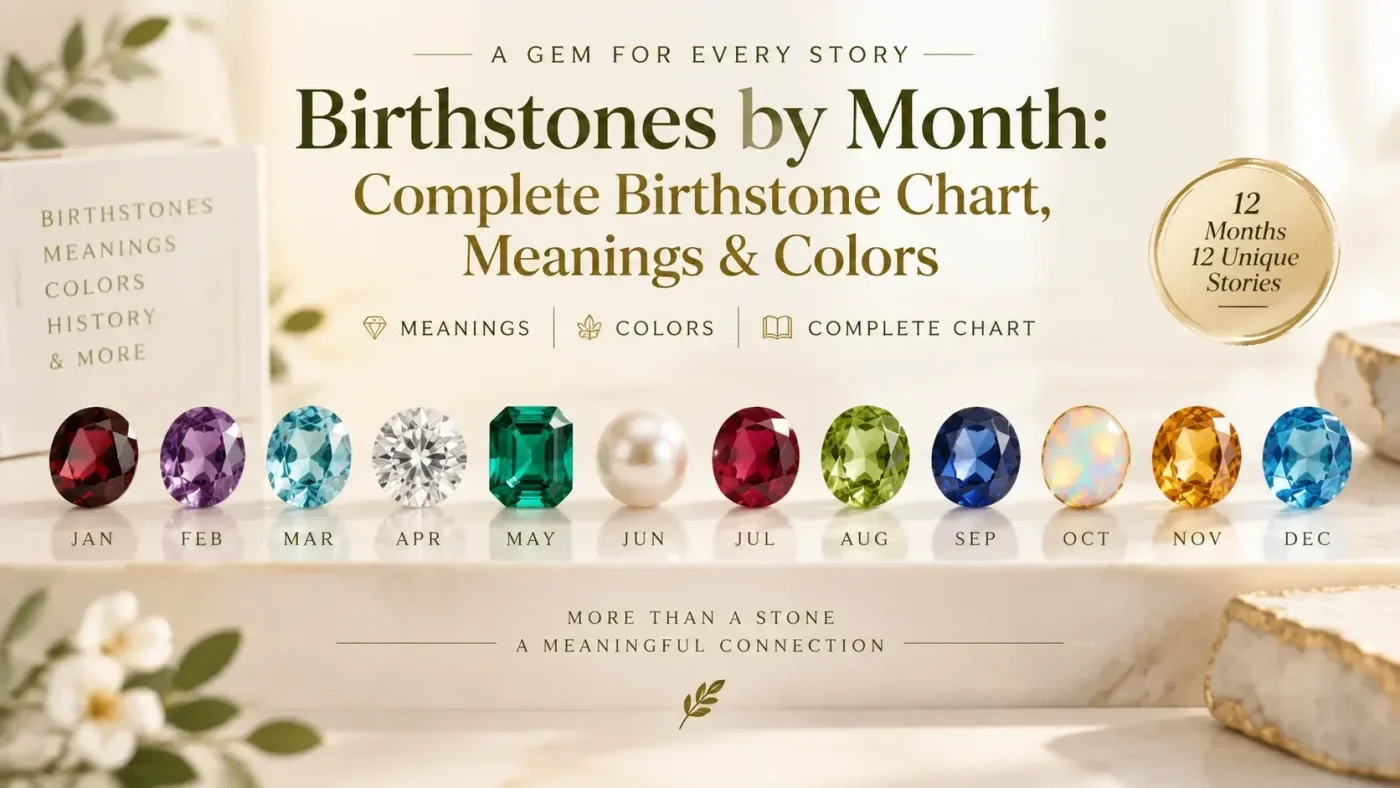
Birthstones are gemstones traditionally associated with each month of the year. Some months have one widely recognized birthstone, while others have several traditional or modern options.
This complete birthstone chart by month explains the main birthstone for every month, common alternatives, typical birthstone colors, traditional meanings, and practical tips for choosing birthstone jewelry.
Quick Birthstone Lookup
January: Garnet · February: Amethyst · March: Aquamarine · April: Diamond · May: Emerald · June: Pearl · July: Ruby · August: Peridot · September: Sapphire · October: Opal · November: Topaz · December: Turquoise
Birthstone lists can vary by tradition, country, and jewelry organization. This guide focuses on the most widely recognized modern birthstones while noting common alternatives.
You can quickly check your month and stone with this birthstone calculator .
What Is a Birthstone?
A birthstone is a gemstone traditionally linked with a particular month of birth. People often wear birthstone rings, necklaces, earrings, and bracelets as personal or symbolic jewelry.
The idea of associating gemstones with months has developed through different historical and cultural traditions. Modern birthstones by month lists are more standardized, but some months still have several accepted stones.
Birthstone meanings are based on cultural and historical traditions. Claims that gemstones guarantee luck, healing, protection, or other effects are not scientifically established.
Birthstones by Month Chart
| Month | Main Birthstone | Common Alternatives | Typical Color | Traditional Meaning |
|---|---|---|---|---|
| January | Garnet | — | Deep red | Protection, friendship |
| February | Amethyst | — | Purple | Clarity, calm |
| March | Aquamarine | Bloodstone | Pale blue | Serenity, courage |
| April | Diamond | — | Colorless | Strength, enduring love |
| May | Emerald | — | Green | Renewal, love |
| June | Pearl | Alexandrite, Moonstone | White, cream, color-changing | Wisdom, purity |
| July | Ruby | — | Red | Passion, vitality |
| August | Peridot | Spinel, Sardonyx | Yellow-green | Prosperity, protection |
| September | Sapphire | — | Blue | Wisdom, loyalty |
| October | Opal | Tourmaline | Multicolor, pink | Creativity, hope |
| November | Topaz | Citrine | Yellow, golden | Warmth, abundance |
| December | Turquoise | Tanzanite, Zircon | Blue to blue-green | Protection, good fortune |
January Birthstone: Garnet
The January birthstone is garnet. Although garnet is most strongly associated with deep red, garnets can naturally occur in several colors.
The traditional birthstone color for the month of January is dark red or reddish burgundy. Garnet has historically been associated with protection, friendship, loyalty, and commitment.
February Birthstone: Amethyst
Amethyst is the birthstone for February. It is a purple variety of quartz and can range from pale lilac to deep violet.
Amethyst has traditionally been linked with calm, clarity, balance, and thoughtful decision-making.
March Birthstones: Aquamarine & Bloodstone
The best-known March birthstone is aquamarine, a gemstone associated with pale blue to blue-green colors.
Bloodstone is another traditional March stone. It is usually dark green with red or reddish inclusions.
The most commonly recognized birthstone color for the month of March is light blue because aquamarine is the modern primary choice.
April Birthstone: Diamond
The April birthstone is diamond. This makes April the month most strongly associated with the diamond birthstone.
Colorless diamonds are the most familiar, but natural diamonds can also occur in colors such as yellow, brown, pink, blue, and green.
Diamond has traditionally symbolized strength, endurance, commitment, and lasting love.
May Birthstone: Emerald
The May birthstone is emerald. Its defining color is green, ranging from lighter green to rich, saturated green.
If you are asking what is the birthstone for May, emerald is the widely recognized modern answer.
The traditional May birthstone color is green. Emerald has long been associated with renewal, growth, love, and prosperity.
Natural emeralds frequently contain visible inclusions. These internal features are common and do not automatically mean the stone is fake.
June Birthstones: Pearl, Alexandrite & Moonstone
June is one of the months with several accepted birthstones. Its best-known options are pearl, alexandrite, and moonstone.
- Pearl: commonly white, cream, silver, pink, or other natural and treated colors.
- Alexandrite: famous for changing color under different lighting conditions.
- Moonstone: often appears milky white with a blue or rainbow-like sheen.
Because June has several birthstones, there is no single universal June birthstone color.
July Birthstone: Ruby
The July birthstone is ruby. Ruby is a red variety of the mineral corundum.
The classic July birthstone color is red, although individual stones can range from pinkish-red to deep red.
For someone looking for a stone for July born family members or friends, ruby is the most widely recognized choice.
Ruby has traditionally represented passion, vitality, courage, and strength.
August Birthstones: Peridot, Spinel & Sardonyx
The most widely recognized modern August birthstone is peridot, although spinel and sardonyx are also accepted.
- Peridot: yellow-green to olive green.
- Spinel: occurs in red, pink, blue, purple, and other colors.
- Sardonyx: typically has reddish-brown and white banding.
The most familiar birthstone color for the month of August is yellow-green because of peridot.
September Birthstone: Sapphire
The birth stone for the month of September is sapphire. Blue is the most famous sapphire color and the color most strongly associated with September birthstones.
Sapphires can naturally occur in many colors. In gemology, red corundum is classified as ruby rather than sapphire.
Sapphire has traditionally represented wisdom, loyalty, truth, and sincerity.
October Birthstones: Opal & Tourmaline
October is associated with both opal and tourmaline.
Opal is famous for its play-of-color, while tourmaline occurs in a wide range of colors. Pink tourmaline is especially popular in October birthstone jewelry.
These stones have traditionally been associated with creativity, imagination, hope, and emotional expression.
November Birthstones: Topaz & Citrine
The birth stone for the month of November is commonly listed as topaz, with citrine also widely accepted.
Topaz occurs in several colors, while citrine is known for yellow to orange shades. Golden and yellow tones are therefore commonly associated with November.
Traditional meanings include warmth, abundance, optimism, and positive energy.
December Birthstones: Turquoise, Tanzanite & Zircon
If you are asking what is the birthstone for the month of December, there is more than one accepted answer.
The most widely recognized December stones are turquoise, tanzanite, and zircon.
- Turquoise: blue to blue-green.
- Tanzanite: blue to violet-blue.
- Zircon: commonly seen in blue for modern December birthstone jewelry.
The most familiar December birthstone color is therefore blue or blue-green.
Birthstone Colors by Month
| Month | Common Birthstone Color |
|---|---|
| January | Deep red |
| February | Purple |
| March | Pale blue |
| April | Colorless |
| May | Green |
| June | White, cream, or color-changing |
| July | Red |
| August | Yellow-green |
| September | Blue |
| October | Multicolor or pink |
| November | Yellow or golden |
| December | Blue or blue-green |
These are common birthstone color associations. Many natural gemstones occur in multiple colors, so a gemstone does not always have one fixed shade.
Why Do Some Months Have More Than One Birthstone?
Some birthstone months have several accepted gemstones because birthstone traditions changed over time.
Historical lists, regional customs, gemstone availability, affordability, and modern jewelry standards have all influenced which stones are associated with each month.
That is why June, August, October, November, and December are commonly shown with multiple birthstone options.
Traditional vs Modern Birthstones
Traditional birthstone lists developed through older religious, cultural, and regional customs. Modern lists were later standardized more clearly for jewelry use.
| Traditional Lists | Modern Lists |
|---|---|
| Can vary by culture and time period | More standardized for jewelry buyers |
| May include older gemstone names | Uses widely recognized commercial gemstone names |
| Often based on historical symbolism | Often balances tradition, availability, and jewelry use |
Are Birthstones and Zodiac Gemstones the Same?
No. Birthstones by month are based on the calendar month in which a person was born. Zodiac gemstones are associated with astrological signs.
Because zodiac signs do not line up exactly with calendar months, a person’s zodiac stone may be different from their monthly birthstone.
Zodiac gemstone associations are part of astrological and cultural traditions rather than scientific classifications.
Which Birthstones Are Good for Everyday Wear?
If you are choosing a birthstone for a ring or another piece of jewelry that will be worn frequently, durability matters.
Very Durable Choices
Diamond, ruby, and sapphire are among the more durable birthstones for regular wear.
Need More Care
Pearl, opal, turquoise, and moonstone generally require more careful handling.
Durability does not mean a gemstone is indestructible. Even harder stones can chip or fracture if struck in the wrong way.
How to Choose Birthstone Jewelry
- Confirm the birth month. Start with the correct month and its accepted birthstones.
- Check alternatives. Some months have multiple suitable gemstones.
- Choose a preferred color. Alternative stones can offer very different looks.
- Consider durability. Rings usually experience more wear than pendants or earrings.
- Set a budget. Prices vary widely by gemstone, quality, size, treatment, and origin.
- Check whether the stone is natural, lab-grown, or a simulant.
Natural vs Lab-Grown Birthstones
Natural gemstones form through geological or biological processes in nature. Lab-grown gemstones are created under controlled conditions and, depending on the gem, can have essentially the same crystal structure and chemical composition as their natural counterparts.
A simulant is different. It is a material that resembles another gemstone visually but has a different composition or structure.
When purchasing higher-value gemstone jewelry, ask the seller to clearly disclose whether the stone is natural, laboratory-grown, treated, or a simulant.
Do Birthstones Really Have Special Meanings?
Birthstone meanings come from historical, cultural, religious, and symbolic traditions.
Many people enjoy these meanings as part of the personal significance of birthstone jewelry. However, there is no strong scientific evidence that wearing a birthstone guarantees healing, luck, protection, wealth, or changes in personality.
Their value is often personal: they can represent a birthday, family member, important date, tradition, or simply a favorite gemstone.
Popular Birthstone Gift Ideas
- Birthstone rings
- Pendant necklaces
- Stud earrings
- Bracelets
- Family birthstone jewelry
- Personalized pieces combining several birth month gemstones
Quick Birthstone List by Month
Each card uses a subtle accent inspired by the stone’s most familiar color, while keeping the overall design soft and elegant.
Common Birthstone Myths
- Myth: Every month has only one birthstone. Several months have multiple accepted stones.
- Myth: Every birthstone has one fixed color. Many gemstones naturally occur in multiple colors.
- Myth: Birthstone meanings are scientifically proven. Their meanings are primarily cultural and symbolic.
- Myth: Lab-grown gemstones are always fake. Many lab-grown stones have the same basic composition and crystal structure as natural versions.
- Myth: All birthstones are equally durable. Gemstone hardness and toughness vary substantially.
- Myth: Birthstones and zodiac gemstones are always the same. They come from different systems.
FAQs About Birthstones
What is my birthstone?
Your birthstone is based on your birth month. For example, January is associated with garnet, May with emerald, July with ruby, and September with sapphire.
What are the birthstones for each month?
The most widely recognized main stones are garnet, amethyst, aquamarine, diamond, emerald, pearl, ruby, peridot, sapphire, opal, topaz, and turquoise from January through December.
What is the January birthstone?
Garnet is the January birthstone and is most commonly associated with a deep red color.
What is March's birthstone?
Aquamarine is the most widely recognized modern March birthstone, while bloodstone is a traditional alternative.
Which month has diamond as its birthstone?
Diamond is the primary birthstone for April.
What is the birthstone for May?
Emerald is the birthstone for May, and green is its characteristic birthstone color.
What color is the June birthstone?
June has multiple birthstones. Pearl is commonly white or cream, alexandrite can change color under different lighting, and moonstone often has a pale body color with a blue or rainbow-like sheen.
What is the July birthstone?
Ruby is the July birthstone, and red is its most recognized color.
What is the August birthstone color?
Yellow-green is the color most commonly associated with August because peridot is the most recognized modern August birthstone.
What is September's birthstone?
Sapphire is the September birthstone. Blue is the classic color, although sapphires occur naturally in several other colors.
What is the November birthstone?
Topaz and citrine are both widely accepted November birthstones.
What is the December birthstone?
December has several accepted birthstones, including turquoise, tanzanite, and zircon.
Can birthstones come in different colors?
Yes. Many gemstone species naturally occur in multiple colors, even when one color is most strongly associated with a particular birth month.
Birthstones by Month: Key Takeaways
- Each month has at least one widely recognized birthstone.
- Some months have multiple traditional or modern birthstones.
- Birthstone colors are common associations, not strict rules for every gemstone.
- Traditional meanings are cultural and symbolic rather than scientifically proven effects.
- Gemstone durability matters when choosing jewelry for frequent wear.
- Natural, lab-grown, treated, and simulated stones should be clearly identified when buying jewelry.
Bottom Line
A birthstone by month is a gemstone traditionally associated with a person's birth month. The modern birthstone chart makes it easy to identify each month's primary stone, common alternatives, typical colors, and traditional meanings. Choose the stone that best fits your month, preferred color, jewelry style, durability needs, and personal meaning.