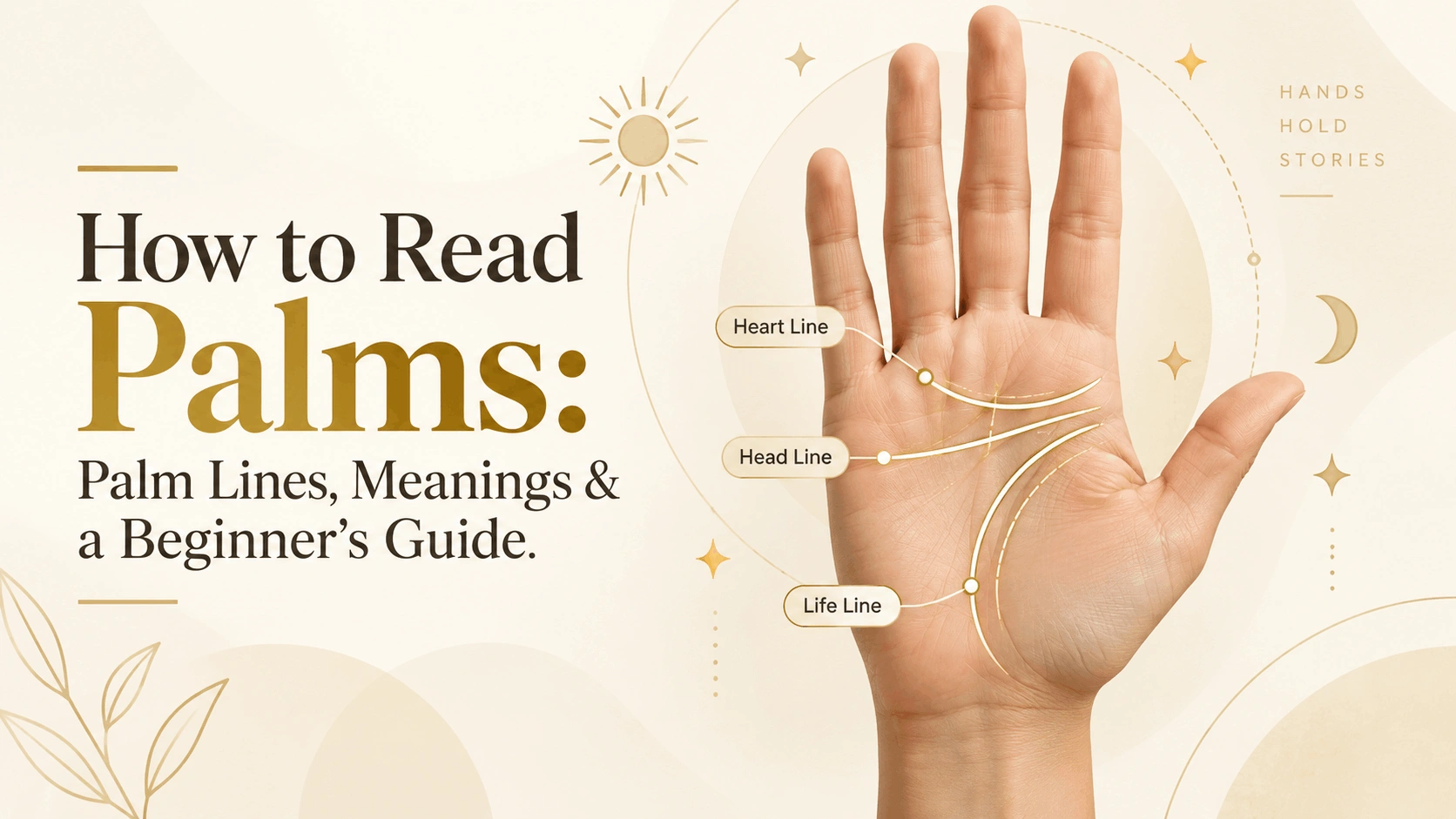
Read a palm in four calm steps
Palm reading is easiest when you observe first, name what you see, and only then compare it with traditional meanings.Choose a hand
Look at both palms. Many traditions compare the non-dominant hand with the dominant hand.Find the three big lines
Start with the heart, head, and life lines before looking for smaller marks.Notice shape and texture
Observe whether lines are straight, curved, deep, faint, joined, or interrupted.Keep it reflective
Treat interpretations as prompts for reflection or cultural interest—not fixed facts about a person.Palm reading—also called palmistry, chiromancy, or hand reading—is a longstanding practice found in different forms across South Asia, China, the Middle East, Greece, and Europe. A traditional reading looks at the shape of the hand, the major creases across the palm, raised areas called mounts, and smaller markings. For a beginner, the best goal is not to make a dramatic prediction. It is to learn where the features are and understand the language palmists traditionally use. Your hand is individual, and plenty of perfectly ordinary hands do not match a neat chart.
Locate the main palm lines
Use the simple diagram as a map, not a test. The exact length, depth, and position of natural palm creases vary from person to person.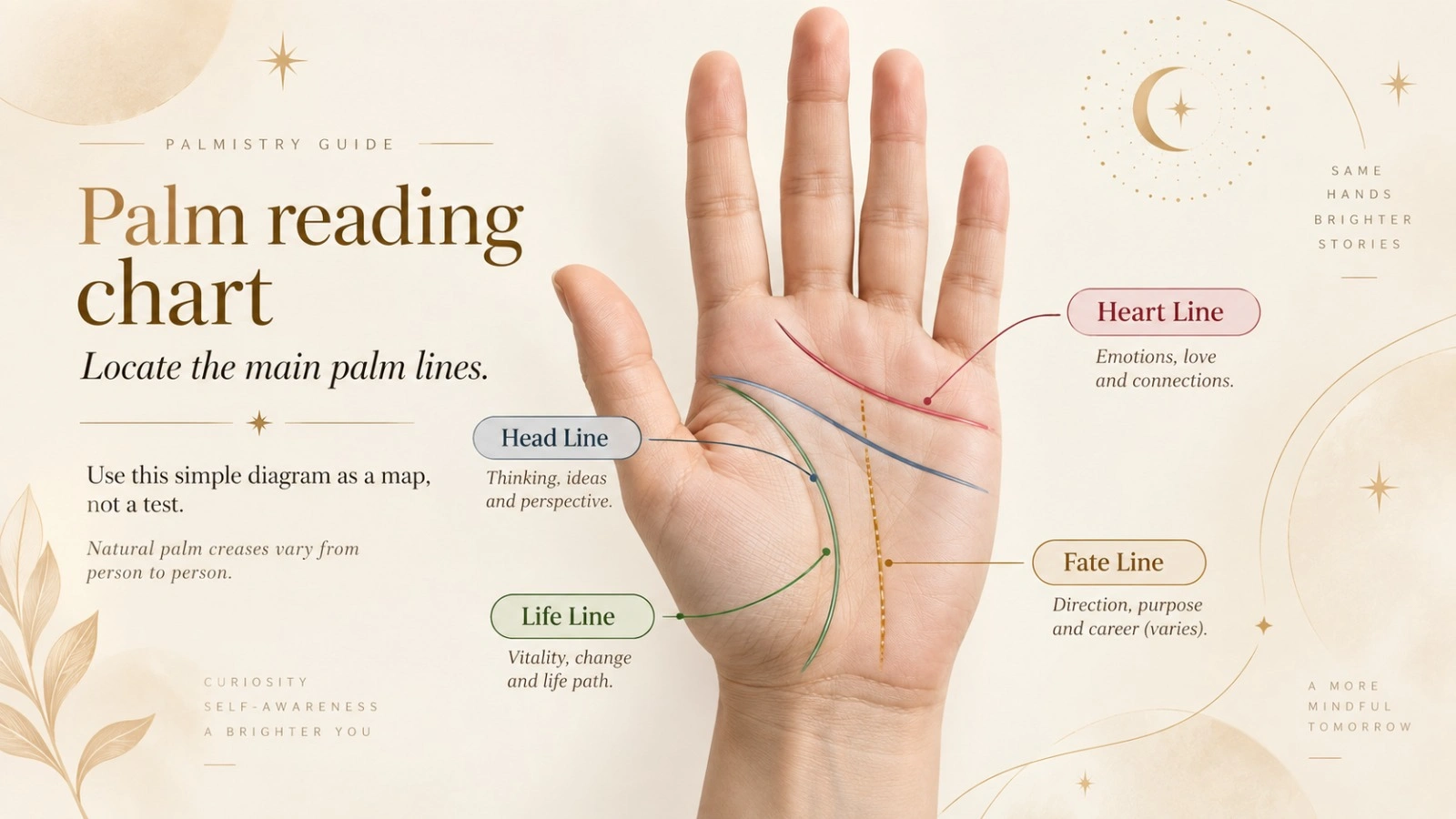
Which hand should you read?
There is no universal rule. A common modern approach is to compare both hands: some palmists treat the non-dominant hand as inherited tendencies or earlier influences, while the dominant hand is read as choices, habits, or how those tendencies are expressed now. Older rules that assign one hand to men and the other to women differ widely by region and school. For a practical beginner reading, use handedness rather than gender: compare both hands, then start with the hand you use most.Traditional hand shapes: an optional first impression
Some palmistry systems group hands into four symbolic “elements.” These categories are interpretive shorthand, not personality science, and many hands show a mix of traits.Fingers and thumb: useful details to notice
Beginner guides often also compare finger length, flexibility, spacing, and the thumb. A longer thumb is traditionally linked with will or independence, while a flexible thumb may be read as adaptability; the index, middle, ring, and little fingers are sometimes associated with ambition, responsibility, expression, and communication. Treat these as symbolic vocabulary, not fixed personality labels. Notice whether fingers sit close together or spread naturally, and whether the thumb opens widely from the palm—then compare the whole hand rather than judging one feature alone.Earth hand
Traditionally: a broad, square palm with shorter fingers; associated with practicality and steadiness.Air hand
Traditionally: a square or rectangular palm with longer fingers; associated with ideas and communication.Water hand
Traditionally: a long, oval palm with long fingers; associated with sensitivity and imagination.Fire hand
Traditionally: a long palm with shorter fingers; associated with energy, action, and enthusiasm.Explore the traditional meanings of each line
Select a line to see where to find it and how it is commonly discussed in palmistry traditions.Heart line: emotion and connection
Look for the uppermost major crease, running below the fingers from the outer edge of the palm toward the index or middle finger. In traditional palmistry, this line is associated with emotional style and relationships. A curve toward the index finger is often read as idealism; a straighter line may be read as a more reserved approach. These are symbolic interpretations, not relationship predictions.Head line: thinking and approach
Usually the middle major crease, beginning near the thumb and index-finger area and traveling across the palm. Palmists traditionally connect this line with learning and mental approach. A relatively straight line is often associated with practical thinking, while a more sloping line is associated with imagination. Neither pattern measures intelligence or diagnoses mental health.Life line: vitality and life experience
Find the arc that starts between the thumb and index finger and curves around the fleshy base of the thumb toward the wrist. Traditionally, palmists connect this line with vitality, grounding, and changes in life experience. It does not reliably predict lifespan. A short, faint, or interrupted life line is not evidence that someone will have a short life or poor health.Fate line: direction and circumstance
When present, it is a vertical line that rises from near the wrist toward the middle finger. It can be faint, partial, doubled, or absent. In palmistry traditions, the fate or fortune line is linked with direction, work, and external circumstances. Not having a visible fate line is common and is not traditionally a negative sign; it is simply read differently by different schools.Sun line: creativity and recognition
This optional vertical line runs upward toward the ring finger. It is also called the Apollo line in some palmistry traditions. Palmists often associate a clear sun line with expression, satisfaction in one’s work, or recognition. It is not a reliable forecast of fame, income, or career success.Relationship lines: connection, not marriage counts
Look on the outer edge of the palm below the little finger, above the heart line. These may appear as short horizontal creases. Traditional guides sometimes connect these marks with meaningful bonds or relationship patterns. They cannot tell you how many relationships or marriages you will have, or whether one will succeed.Mounts: the padded areas of the palm
Palmists also look at the soft raised areas of the palm. These are called mounts and are traditionally named after planets—for example, the Mount of Venus at the base of the thumb, the Mount of Jupiter under the index finger, Saturn beneath the middle finger, Apollo (the Sun) beneath the ring finger, and Mercury beneath the little finger. Some systems also discuss the Moon along the outer lower palm and Mars in the central or outer areas. A traditional reading may describe a fuller or flatter mount as emphasizing certain qualities, such as warmth, ambition, confidence, or communication. This is symbolic vocabulary rather than anatomy or personality assessment.Breaks, forks, islands, and crosses: how to look without overreading
Natural palm creases are rarely perfectly smooth. If you notice a mark, compare it with the rest of the hand and keep your interpretation light. Different palmistry books often disagree about the same feature.Forks
Traditionally read as a branching of attention or direction. In practice, many forks are simply ordinary variations in skin creases.Breaks
Some traditions associate breaks with change or transitions. They should never be used to predict a crisis, illness, or specific event.Islands
An island is an oval-like split and rejoining in a line. Traditional meanings vary greatly, so avoid treating one as a warning sign.Crosses
A crossing line may be given symbolic meaning in some systems, but minor intersecting creases are common on active hands.Do palm lines change?
Fine lines and skin texture can look different over time because of age, hydration, work, injuries, weight changes, lighting, and how you hold your hand. Major creases are usually stable, although their appearance can shift. Palmistry traditions may describe changes symbolically, but there is no evidence that a new line records a predetermined future.Are palms read differently for men and women?
Not in any consistent, evidence-based way. Some older palmistry systems use gendered rules about left and right hands, but these rules conflict across traditions. A respectful modern approach is to compare the dominant and non-dominant hands for anyone, regardless of gender.Is hand reading real?
Palmistry has cultural, historical, and personal meaning for many people, but scientific research does not support the idea that palm lines can reliably predict personality, relationships, health, wealth, or future events. You can still enjoy palm reading as a conversation starter, a family tradition, or a reflective ritual. Just avoid making high-stakes decisions—or giving medical, legal, financial, or relationship advice—based on a hand reading.Try a thoughtful five-minute reading
Use your own hand or ask a friend’s permission. Keep the experience curious, kind, and free of frightening claims.- Look at both hands in good natural light.
- Identify the heart, head, and life lines first.
- Describe what you see before naming a meaning.
- Phrase interpretations as “traditionally associated with,” not certainty.